
Client
SIXT
Deliverables
Enterprise UX Design System UX Research Leadership
Year
2024
Role
Lead Product Designer
Led the end-to-end design of an enterprise SaaS platform that unified five disconnected operational tools into one scalable ecosystem for global fleet management. The platform streamlined rentals, servicing, repairs, logistics and vehicle lifecycle management while replacing spreadsheet-based workflows with a consistent, user-centered experience across multiple international markets.

Outcome
The project transformed a fragmented operational ecosystem into a unified enterprise platform supporting the complete fleet lifecycle.
By consolidating multiple internal products into a single experience, the solution simplified complex workflows, standardized operations across international markets and established a scalable foundation for future product growth.
5 Systems Unified
Consolidated five independent operational tools into one scalable enterprise platform.
Global Workflow Standardization
Standardized fleet management workflows across international markets for greater consistency.
Reduced Excel Dependency
Replaced spreadsheet-based processes with a centralized digital workflow.
Scalable Design System
Introduced a scalable enterprise design system aligned with SIXT branding.
Operational Visibility
Improved reporting and decision-making through centralized dashboards and data visibility.
End-to-End Fleet Lifecycle
Unified rentals, servicing, repairs and logistics into one connected operational ecosystem.
Key results
Final Impact
The result was more than a redesigned interface. It was a strategic transformation of fleet operations that reduced product fragmentation, improved operational visibility, simplified complex enterprise workflows and created a scalable foundation for future innovation.

Challenges
Designing a fleet management platform at enterprise scale introduced challenges beyond interface design.
The biggest complexity came from aligning different operational models used by multiple countries while supporting highly specialized workflows for dispatchers, fleet managers, maintenance teams and branch employees. Existing tools had evolved independently over many years, resulting in inconsistent terminology, duplicated functionality, and fragmented user journeys.
Another major challenge was balancing business requirements with operational efficiency without disrupting critical day-to-day processes.
Objectives
The project focused on several strategic goals:
Replace multiple disconnected internal tools with a unified platform
Simplify complex operational workflows
Standardize processes across international markets
Improve efficiency for daily fleet operations
Reduce manual work and spreadsheet dependency
Create a scalable design system
Increase usability while minimizing training effort
Enable future product scalability
Process
Research
Understanding operational complexity required close collaboration with business stakeholders and internal users.
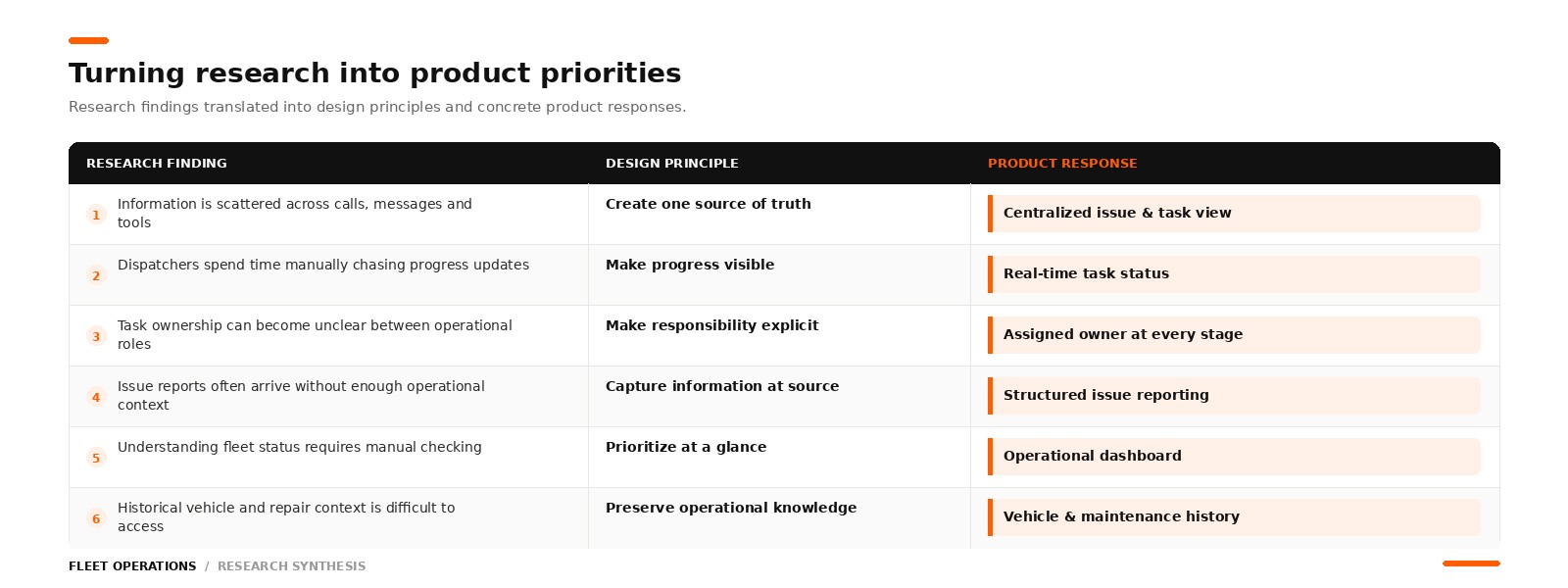
Research included stakeholder workshops, process mapping, workflow analysis, existing product evaluation, competitive benchmarking and usability testing. Together with product managers and engineering teams, we identified bottlenecks, duplicated processes, and opportunities for workflow simplification.
The insights gathered during discovery became the foundation for the platform architecture and future product roadmap.
Strategy
Rather than redesigning existing interfaces, the strategy focused on redesigning the operational ecosystem itself.
We first unified the information architecture and defined consistent interaction patterns before creating individual screens. This approach allowed us to establish common workflows that could scale across products, countries, and future modules.
Parallel to product design, I established a reusable design system that ensured consistency while accelerating collaboration between design and engineering.
Ideation
The ideation process combined business workshops, rapid concept exploration, user flows, wireframes, and iterative prototyping.
Complex workflows were decomposed into smaller interaction patterns before being rebuilt into modular experiences. Early concepts were validated continuously with stakeholders, enabling quick iterations and reducing implementation risks.
This iterative approach ensured that design decisions remained grounded in operational realities rather than assumptions.
Validation
Throughout the project, prototypes were validated through regular usability testing and stakeholder reviews.
Testing focused on navigation, task completion, workflow efficiency and discoverability of key actions. Feedback from operational teams helped refine interactions, simplify complex scenarios and improve overall usability before development.
Continuous validation significantly reduced uncertainty during implementation while increasing confidence across business and engineering teams.

Final thoughts
This project demonstrated that enterprise design is about far more than creating polished interfaces.
The greatest value came from simplifying complexity, aligning international business processes and building a product foundation capable of supporting future growth.
Beyond designing the platform itself, the project strengthened collaboration across multidisciplinary teams, introduced a scalable design system and helped transform fragmented operational workflows into a unified enterprise experience.