Client
HOLVI
Deliverables
UX Research Information Architecture User flows UI Design Usability Testing
Year
2022
Role
Senior Product Designer
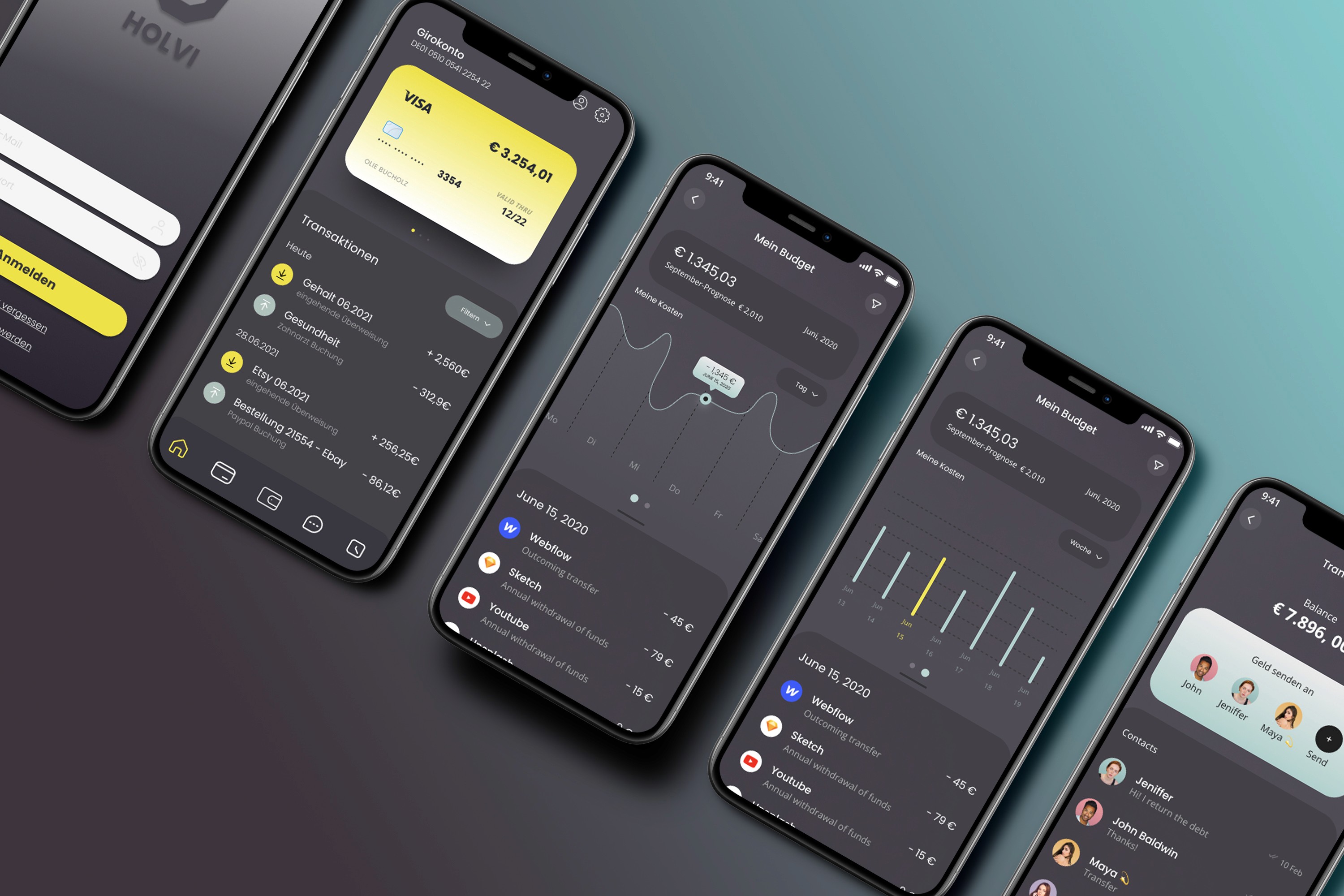
Redesigning a growing mobile banking product for freelancers and small businesses by restructuring information architecture, simplifying high-frequency financial workflows and reducing complexity across everyday banking tasks.
Outcome
The redesign created a clearer structure for a product that had grown increasingly complex over time. Core banking tasks became easier to find and complete, while a simplified information architecture and reusable interaction patterns created a stronger foundation for future functionality.
32% Faster Task Completion
Core financial tasks completed more efficiently.
41% Higher Task Success
Improved navigation increased successful task completion.
28% Lower User Drop-off
Simplified payment and invoicing journeys reduced abandonment.
5 Core Banking Flows Redesigned
Payments, invoicing, transactions, navigation and account management.
4 Research Methods Combined
User interviews, analytics, surveys and competitor analysis.
Mobile-first Experience
Designed for freelancers managing finances on the go.
Key results
Final Impact
The redesign demonstrated that simplifying a financial product does not mean reducing what it can do.
By restructuring the product around real user priorities, the experience became easier to navigate while preserving the breadth of functionality required by freelancers and growing businesses.
The resulting architecture and interaction patterns also created a stronger foundation for future product expansion without repeating the complexity that triggered the redesign.

Challenges
The product had grown significantly over time, but the experience had not evolved at the same pace.
New functionality increased navigation complexity, core banking journeys accumulated unnecessary steps, and important financial information became harder to locate quickly.
The challenge was not to reduce the product's capabilities, but to make that complexity easier to navigate for different types of business users.
Objectives
The objective was to simplify everyday banking without stripping away the functionality business users relied on.
The redesign focused on three areas: making high-frequency actions easier to access, restructuring the information architecture around real user priorities and simplifying complex financial journeys without reducing control.
Process
Research & Analysis
Research focused on understanding how freelancers and small business owners used the existing product in everyday financial work.
Qualitative interviews, behavioral analysis, competitor benchmarking and existing-product analysis were used to identify where navigation, payments, invoicing and transaction management created unnecessary effort.
Rather than treating each usability issue in isolation, findings were synthesised into recurring patterns around discoverability, task frequency, decision complexity and information hierarchy.
Strategy
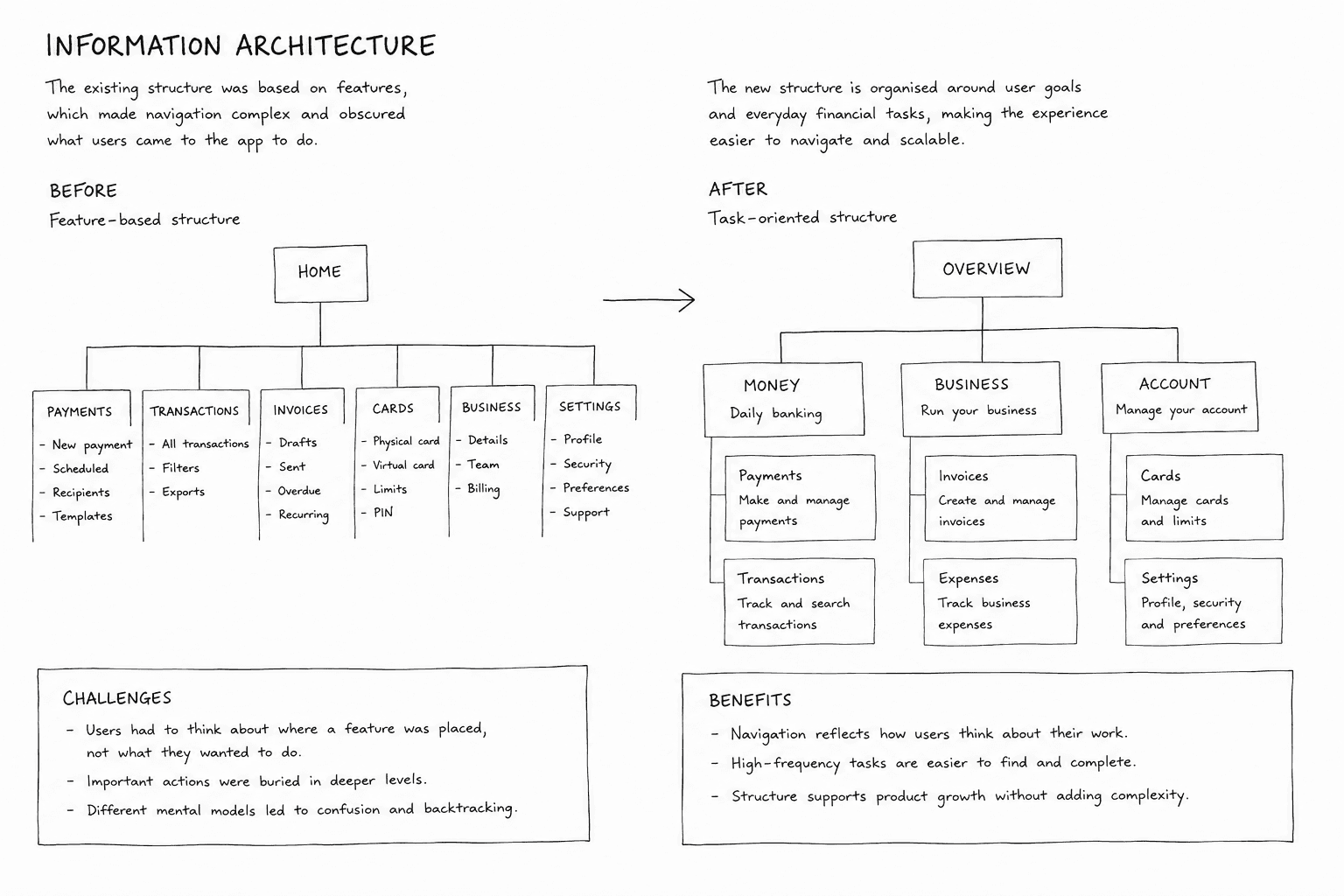
Research findings were translated into a new structural model for the mobile experience.
High-frequency tasks were prioritised, related functionality was regrouped and navigation was reorganised around how users actually managed their finances rather than around the product's internal feature structure.
The strategy followed one principle: keep powerful functionality available, but expose complexity only when it becomes relevant to the task.
Ideation
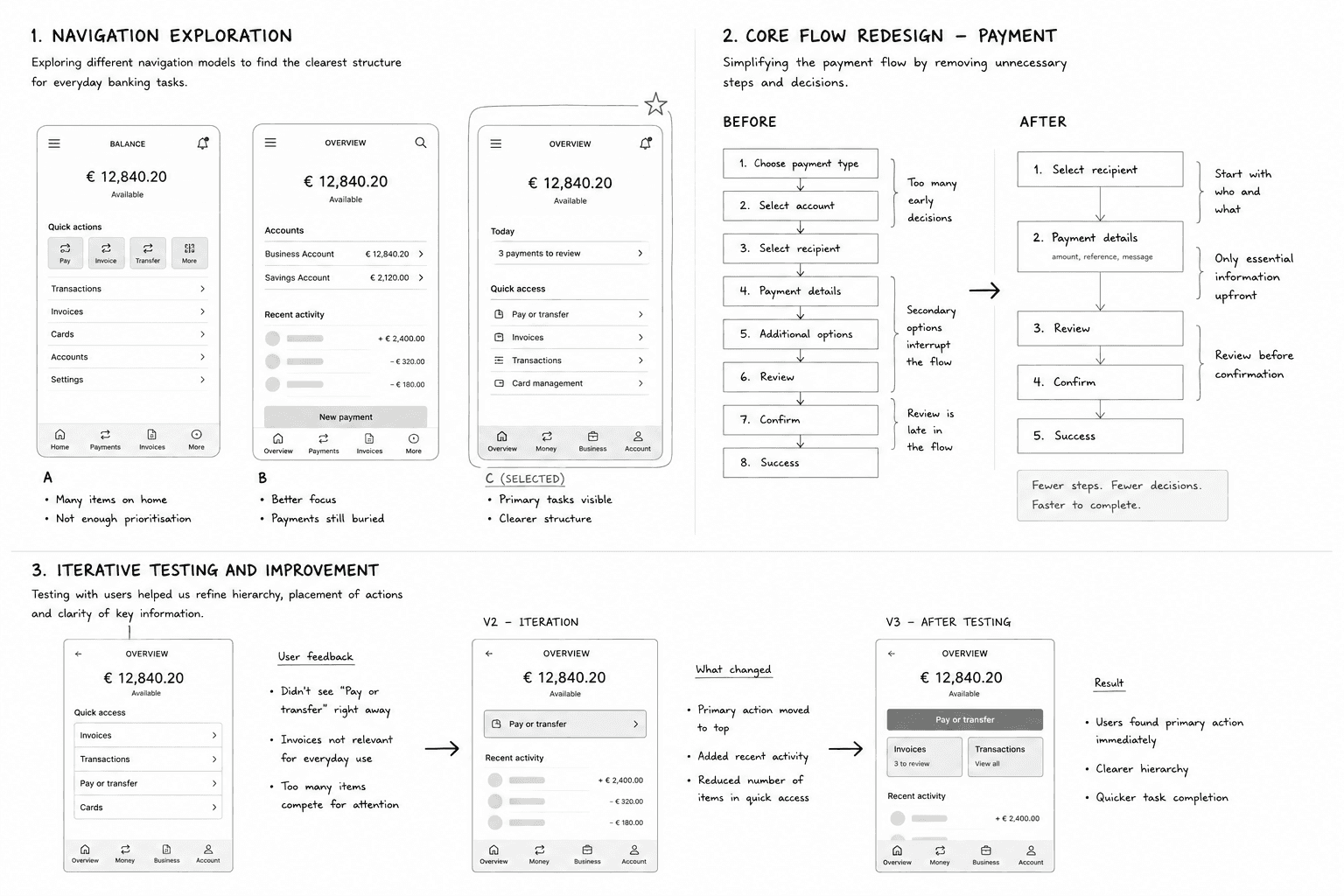
The redesign was explored through low- and mid-fidelity wireframes before moving into polished UI.
Different navigation models, grouping strategies and interaction patterns were compared across core banking journeys. The goal was to test structure and flow first, without allowing visual styling to hide usability problems.
Selected directions were then refined into high-fidelity interfaces using reusable components and established product patterns.
Core flow redesign
Interactive prototypes were validated through usability testing and design reviews. Feedback from users and stakeholders informed several iterations before implementation, ensuring the redesigned experience addressed both usability and business requirements.
Testing & Validation
Interactive prototypes were used to validate navigation, information hierarchy and core banking journeys before implementation.
Testing focused on whether users could quickly identify where to begin, understand what information was required and complete financial tasks without unnecessary backtracking.
Findings informed several iterations to navigation, flow structure and interaction patterns before the experience moved into implementation.
Final thoughts
Complexity is not inherently a UX problem - unstructured complexity is.
This project reinforced the importance of understanding which tasks deserve immediate visibility, which decisions can be postponed and which functionality should remain available without dominating the experience.
The strongest improvements came not from removing banking capabilities, but from changing when and how users encountered them.