
Client
Confidential Enterprise HR Tech Client
Deliverables
UX Research Research Synthesis AI Product Strategy Conversation Design Behavioral Frameworks Rapid Prototyping & Validation
Year
2025
Role
Senior Product Designer - Research & AI UX
Led research and product discovery for an enterprise AI assistant designed to support employees and operational teams in complex workplace environments. The work focused on understanding how people use and evaluate AI, what creates trust, where automation provides real value and which situations still require human expertise. Research findings were translated into product principles, conversation patterns, behavioral requirements and recommendations for the future AI experience. Prototypes and existing interface concepts were used to explore and validate these decisions rather than redesigning the visual system from scratch.

Outcome
The project created an evidence-based direction for the future AI experience.
Research clarified where enterprise users saw genuine value in AI assistance and where important boundaries needed to remain. Trust, correctness, access to reliable knowledge, contextual guidance, privacy and human escalation emerged as stronger product requirements than conversational sophistication alone.
The work also broadened the definition of the assistant beyond question answering. Research showed opportunities for AI to guide employees through processes, connect them with the right information or system, support self-service and reduce repetitive operational work - while preserving access to human expertise when needed.
TRUST - Correctness before confidence
Research established reliable, source-grounded answers and clear knowledge boundaries as core requirements for user trust.
AI ROLE - Answer → Guide → Route → Escalate
The assistant's role expanded beyond Q&A to supporting processes, directing users to the right system and involving humans when needed.
PRODUCT DIRECTION - Embedded, contextual assistance
Research shifted the product direction toward context-aware assistance integrated into existing workplace tools rather than another standalone destination.
PERSONALIZATION - Context without overreach
Users valued role- and organisation-aware responses, but privacy concerns made it essential to use only relevant context and keep data use understandable.
HUMAN SUPPORT - Automation with safety met
Research confirmed that AI should reduce repetitive work without removing access to human expertise for sensitive, complex or uncertain requests.
ADOPTION - Value before novelty
Adoption depended less on introducing another AI feature and more on fitting naturally into existing workflows, providing clear value and earning user confidence over time.
Key results
Key Research Outcomes
The research shifted the product discussion from “What should the chatbot do?” toward “Where can AI create meaningful value - and under what conditions will people trust it?”
Five findings strongly influenced the product direction:
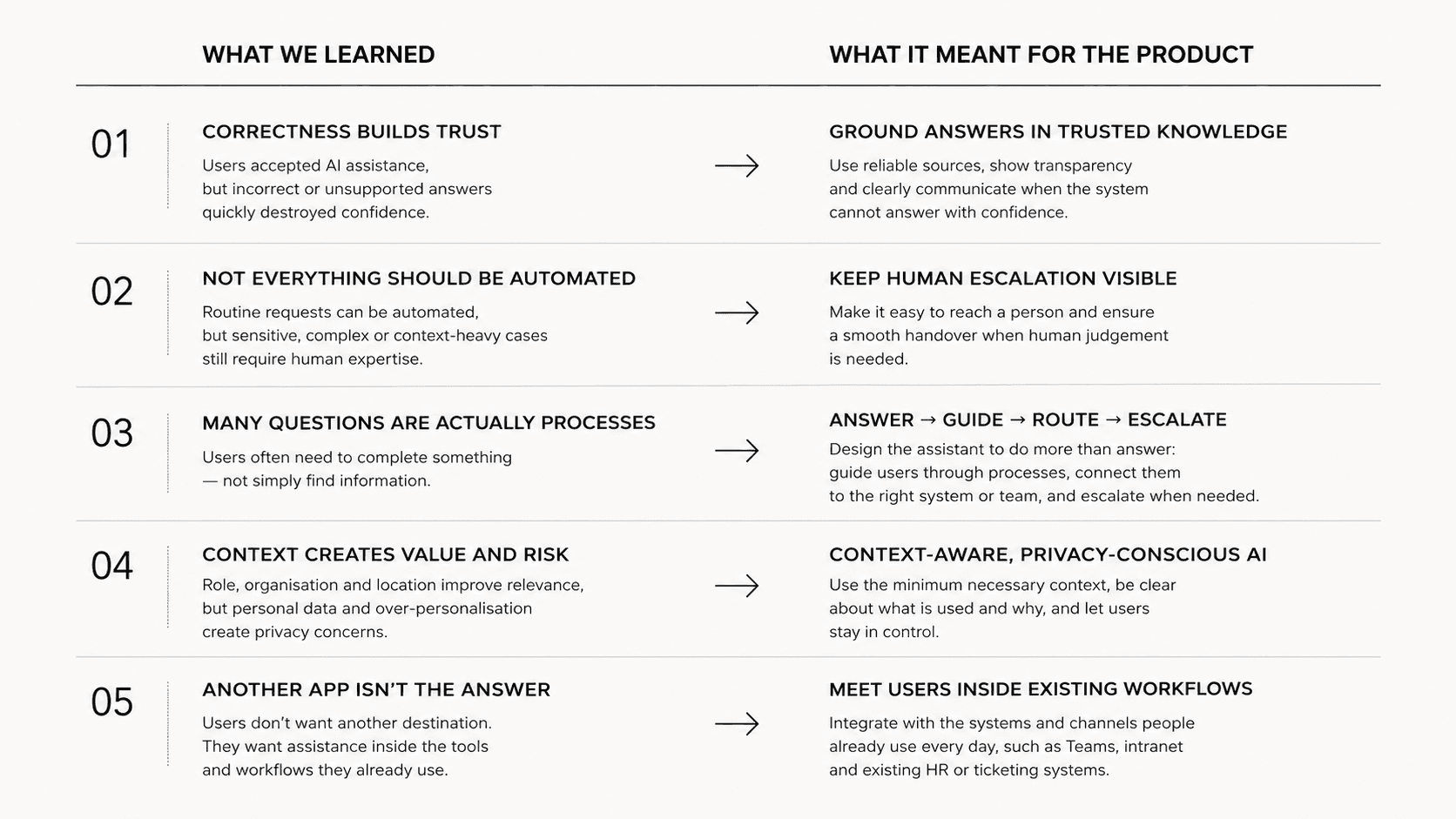
Correctness before confidence - users needed reliable, source-based answers and clear boundaries when the system could not answer safely.
Automation without removing humans - routine questions could be absorbed by AI, but complex and personal requests still required easy access to human support.
Guidance beyond Q&A - many requests involved processes rather than simple information, creating opportunities for the assistant to guide, route and escalate.
Context without overreach - users valued personalization based on role and organisational context, but privacy and data access had to remain carefully controlled.
Integration over another destination - existing workplace channels and systems were often more valuable entry points than introducing another standalone application.

Challenges
The main challenge was not designing another chatbot interface - it was understanding what role an AI assistant should realistically play inside a complex enterprise environment.
Users were already experimenting with AI, but their expectations varied significantly depending on context, sensitivity of the request, existing workflows and previous experiences with automated tools. Research needed to uncover where AI could genuinely reduce effort, what made an answer trustworthy, how much context the system should use and when a human should remain involved.
Key research questions included:
What makes an AI-generated answer trustworthy enough to act on?
Which employee requests can be handled through self-service and which require human expertise?
What should happen when available information is incomplete or uncertain?
How much personalization creates value without creating privacy concerns?
Should the assistant become another destination, or live inside existing workplace tools?
Where can AI move beyond answering questions and actively guide users through processes?
What creates enough value for employees and organisations to drive adoption?
Objectives
The objective was to build an evidence-based understanding of how enterprise users expect AI assistance to work before defining future product behavior.
The research aimed to:
understand current employee-support and information workflows
identify recurring user needs, frustrations and workarounds
understand existing attitudes toward AI and automation
uncover the conditions required for users to trust AI-generated answers
define appropriate boundaries between automation and human support
identify opportunities for contextual and personalized assistance
understand where integrations could create more value than a standalone product
translate research findings into actionable product principles and future priorities
Process
RESEARCH
The project was heavily research-driven. Before making decisions about future AI behavior, I focused on understanding how employees and HR teams were already finding information, handling recurring requests and using AI in their day-to-day work.
The research combined qualitative interviews with existing customers, pilot organisations and internal stakeholders with workflow analysis, evaluation of existing AI and chatbot experiences, and investigation of current support and information processes. Participants represented different organisational realities, including HR operations, payroll, HR systems and digitalisation roles.
Rather than asking users what features they wanted, I explored the context behind their requests: where information was difficult to find, which questions repeatedly reached HR teams, where current tools failed, what users considered trustworthy and which interactions they would never fully delegate to AI.
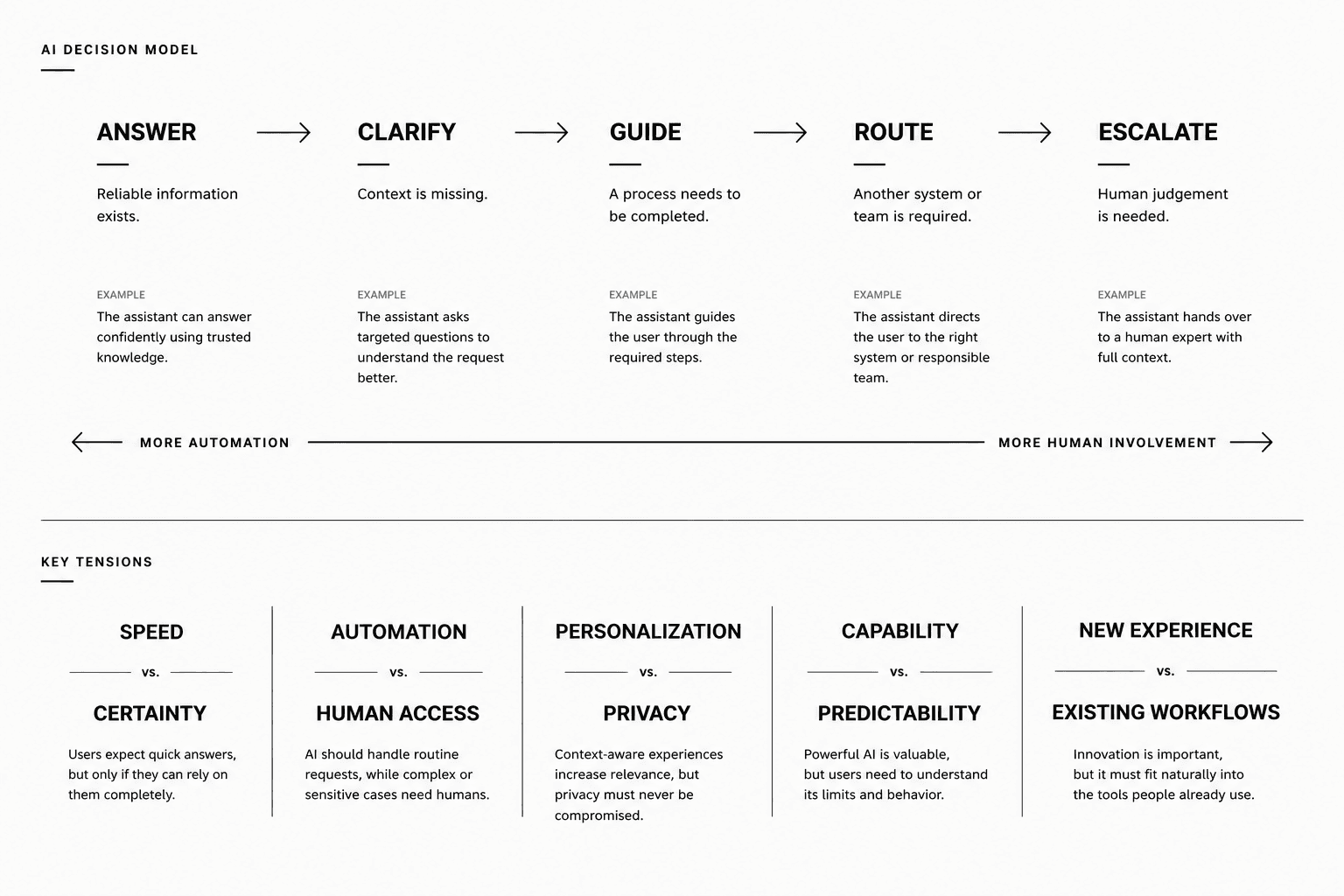
Several recurring tensions emerged - users wanted faster self-service but still expected access to human experts. They valued contextual answers but were cautious about personal data. They were interested in AI-generated guidance but highly sensitive to incorrect or legally unreliable information. And in many cases, they did not want another application at all - they wanted assistance embedded in the tools they already used.
The synthesis transformed individual observations into a set of recurring themes around trust, correctness, context, privacy, human escalation, integration and organisational adoption. These themes became the foundation for subsequent product decisions.
STRATEGY
The next step was translating research evidence into a clearer definition of what the AI assistant should - and should not - do.
One of the strongest findings was that trust depended less on how intelligent or human the assistant appeared and more on whether users believed its information was correct, relevant and grounded in appropriate sources. In sensitive HR contexts, a plausible but incorrect answer could create significantly more risk than admitting that the system could not answer.
The research also reframed automation. The opportunity was not to replace HR expertise, but to absorb repetitive requests, guide employees through common processes and help them reach the right person or system when a request became more complex.
This led to a behavioral model based on several principles: answer when reliable information is available, clarify when context is missing, guide when a process is involved, route when another system is required, and escalate when human expertise is more appropriate.
These principles provided a shared framework for product, design and technical discussions around future AI behavior.
IDEATION
Because the visual direction and core interface structure were already largely established, exploration focused primarily on behavior rather than visual reinvention.
Research findings were translated into scenarios, conversation patterns, flows and prototypes that made different AI behaviors tangible. The work explored how the assistant could handle ambiguous questions, request missing context, surface relevant information, guide users through multi-step processes and transition from automated support to human assistance.
Prototypes also helped explore some of the tensions identified during research - particularly personalization versus privacy, direct answers versus guided conversations and automation versus user control.
AI-assisted exploration accelerated early scenario generation, while Figma was used to refine and communicate interaction concepts within the existing product language.
VALIDATION
Research and validation were iterative rather than separate phases. Emerging assumptions were continuously challenged against customer feedback, stakeholder knowledge and realistic enterprise scenarios.
Prototypes were used to evaluate whether the proposed behaviors reflected the needs uncovered during research: whether users understood the assistant's responses, whether they knew when information could be trusted, whether escalation felt natural and whether the experience supported rather than interrupted existing workflows.
Validation also helped distinguish desirable AI capabilities from those that created unnecessary complexity. Some of the strongest opportunities were not additional interface features, but better access to trusted knowledge, customer-specific content, contextual assistance and integrations with existing workplace systems.
The process ultimately reinforced a core principle: successful enterprise AI depends as much on defining its boundaries as on extending its capabilities.
Final thoughts
Designing for AI extends far beyond creating interfaces.
The most important work in this project happened before deciding what another screen should look like. Research helped define what users were willing to delegate to AI, what they needed in order to trust it, where organisational workflows created friction and where human expertise still mattered.
The project reinforced a principle that became central to my approach to AI product design: more capable AI does not automatically create a better product. The real design challenge is deciding when the system should answer, when it should ask, when it should act - and when it should step aside.
By grounding those decisions in real customer needs and operational realities, research provided a credible foundation for future AI product development.